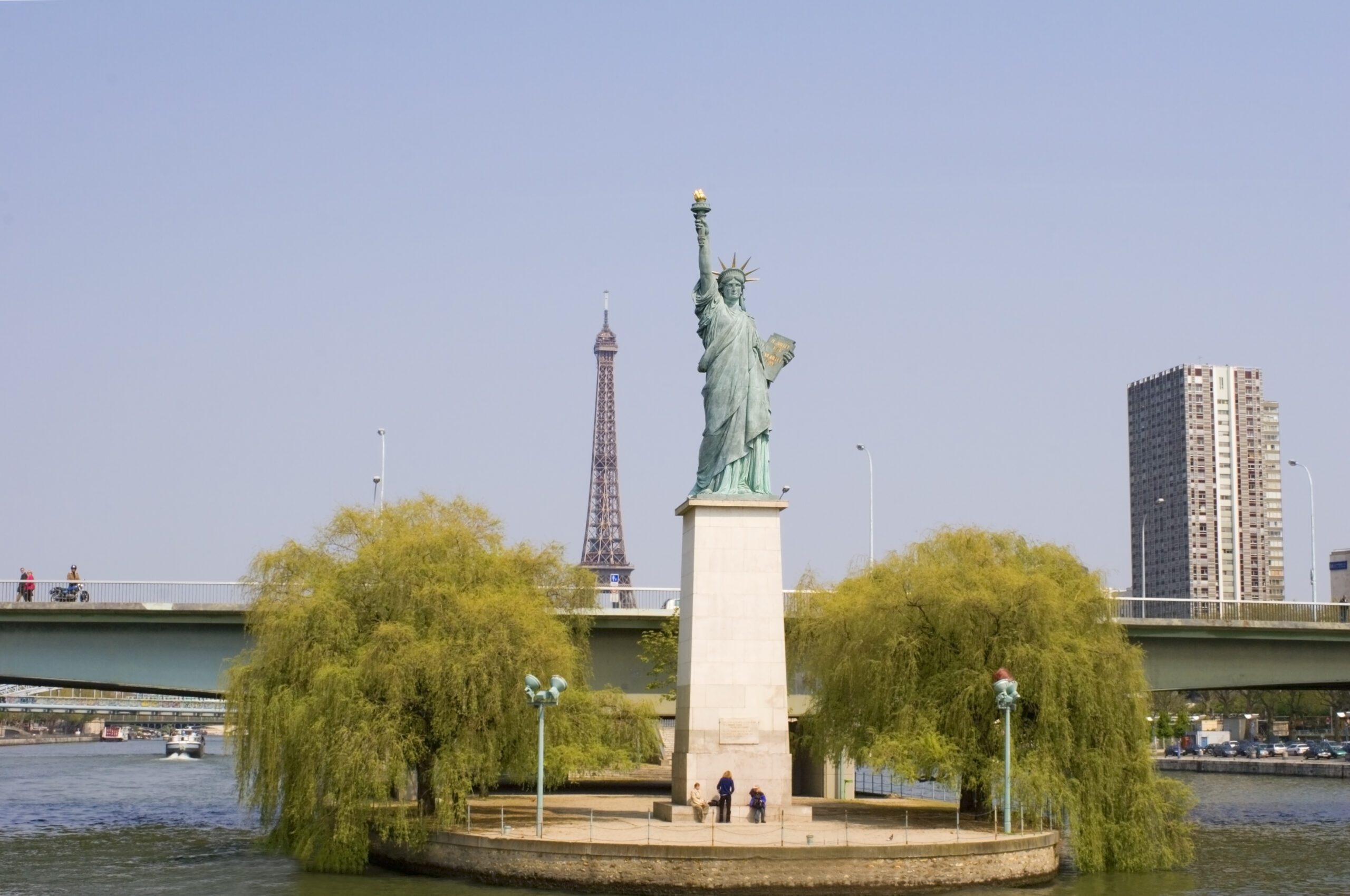
The Statue of Liberty Paris visitors are most likely to walk past without recognizing stands on a narrow artificial island in the Seine, facing west toward New York. She is a quarter the size of the one in the harbor. She holds a tablet inscribed with two dates, not one. Most people who pass her on the Bir-Hakeim Bridge never stop to ask why she is there.
The answer to that question is one of the most interesting stories in the history of the relationship between France and the United States — and it begins not with a sculptor or a statue, but with a 19-year-old French aristocrat who crossed the Atlantic in 1777 to fight for a country that was not yet a country.
That story is also why my 2027 Emily in Paris group journey matters as more than a set-jetting experience. Paris is not a backdrop. It is a place where American history is literally written in bronze, on an island in the middle of a river, for anyone willing to stop and read it.
Where the Paris Statues Actually Stand
Paris has five notable versions of the Statue of Liberty, and they are not all in obvious places.
The most significant stands at the western tip of the Île aux Cygnes, a narrow man-made island in the Seine near the Eiffel Tower. Standing at 22 meters tall, this replica faces west toward its larger counterpart in New York Harbor. French President Sadi Carnot unveiled the statue on July 4, 1889, the anniversary of American Independence. The tablet she holds bears two dates: July 4, 1776, and July 14, 1789, representing American Independence and the storming of the Bastille. The symmetry of those two dates is not accidental. It is the entire argument.
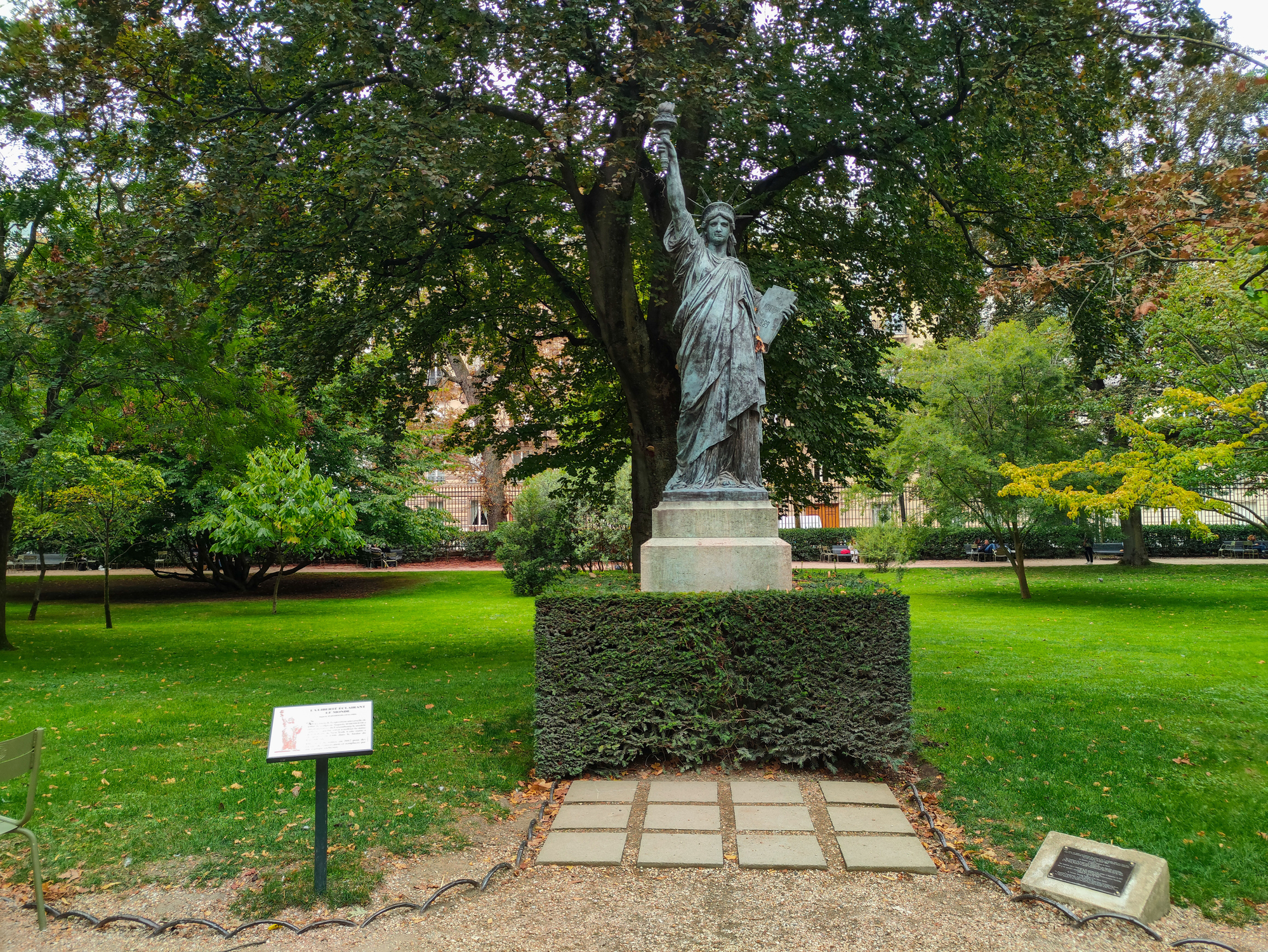
The second location most worth knowing is the Jardin du Luxembourg in the 6th arrondissement. The Luxembourg Gardens model was the one Bartholdi originally used to create the larger statue for the United States. Frédéric-Auguste Bartholdi exhibited the original scale model at the 1900 Universal Exhibition in Paris, moved it to the Luxembourg Museum in 1905, and eventually relocated it to the Musée d’Orsay for conservation. The version currently standing in the gardens is a cast of that original replica. It is smaller than most visitors expect and more significant than most realize.
The Musée des Arts et Métiers in the Marais district holds a plaster model recovered from Bartholdi’s original workshop, along with an interactive guide to the statue’s construction. For anyone interested in the craft behind the monument, this is the stop most guidebooks undervalue.
The fifth location requires no detour because most Paris visitors pass it without realizing its connection to Liberty. Near the Pont de l’Alma, a full-size gold-leaf replica of the Statue of Liberty’s flame stands at the entrance to the tunnel where Princess Diana died in 1997. Readers of the International Herald Tribune gave it to France in 1989 to recognize the friendship between France and the United States. The flame arrived as a symbol of Franco-American friendship. History gave it a second meaning nobody planned.
Why France Gave the Statue of Liberty to America
The standard answer is that France gave the Statue of Liberty to the United States as a centennial gift celebrating American independence. That answer is accurate and incomplete.
In 1865, a group of French Republican Americans wanted to offer a gift to the United States as a testimony of Franco-American friendship and to celebrate the centenary of the American Declaration of Independence. In 1871, Auguste Bartholdi was chosen to design it. The gift was as much a political statement as a diplomatic one. France under Napoleon III operated under an authoritarian government that Republican French citizens found deeply uncomfortable. Bartholdi said as much directly: he saw the statue as a way to celebrate the republic he could not yet find at home.
The statue depicting Liberty enlightening the world expressed something more specific: French admiration for the American political experiment and its influence on the French Revolution of 1789. For over 125 years, the Statue of Liberty has symbolized the relationship between France and the United States. The two revolutions are inseparable. The statue was always meant to make that argument permanent.
What the standard story leaves out is the man who made both revolutions possible for each other.
What Lafayette Has to Do With Any of It
In 1777, a 19-year-old French aristocrat arrived on the eastern shores of an infant nation and forever changed the course of United States history. Gilbert du Motier, Marquis de Lafayette, received a commission as a major general in the Continental Army. He fought at Brandywine, in Rhode Island, and at the eventual British surrender at Yorktown. His participation in the American Revolution entrenched France’s status as the oldest United States ally.
Lafayette in the American Revolution and France’s role in the founding of the United States is the connective tissue running underneath every Paris Statue of Liberty. The French did not give America that monument out of abstract goodwill. They gave it because a French general bled for American independence a century before the sculptor picked up his tools.
Washington, who had no biological children of his own, came to view the young Frenchman as an adopted son. For Lafayette, who had lost his father in battle at the age of two, Washington became the father figure he never had. This relationship became the emotional core of the Franco-American alliance.
Lafayette’s legacy extends beyond the Revolution. He inspired the Statue of Liberty, helped facilitate America’s entry into the Great War in 1917, and remains an emblem of Franco-American relations. The connection did not end with the Revolution. It runs forward through two world wars and into the present.
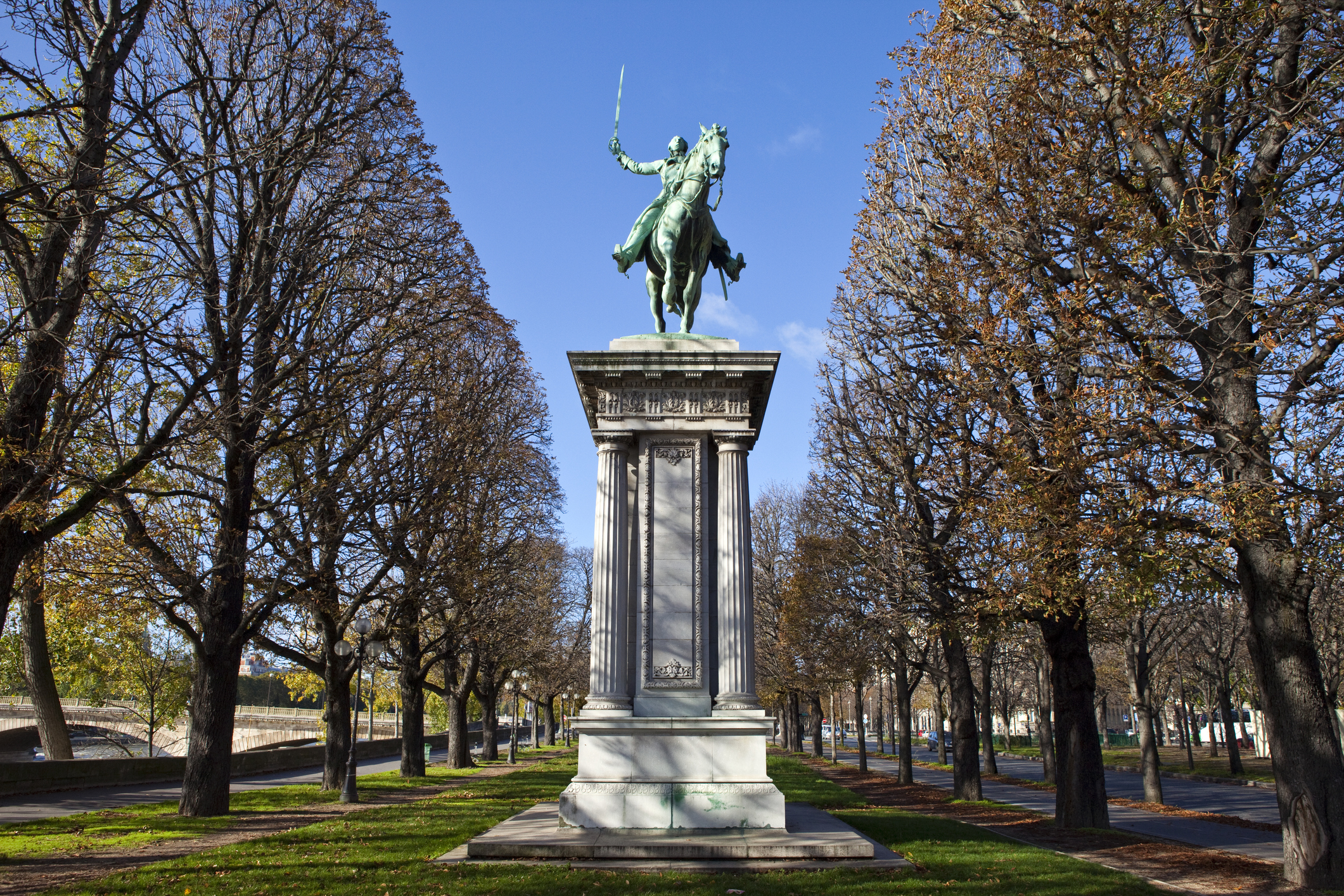
Paris remembers this. On the Cours de la Reine, a walkway along the right bank of the Seine near the Alexandre III Bridge, an equestrian statue of Lafayette depicts him with his sword aloft. America erected it in 1908 as a direct response to France’s gift of the Statue of Liberty. Two countries, two monuments, one relationship. The exchange is visible in the city for anyone who arrives knowing where to look.
What This Means If You Are Going to Paris
Most visitors to Paris walk across the Bir-Hakeim Bridge, glance at the statue below, and keep moving. The ones who stop, who walk down to the island’s tip and read the tablet dates, who understand what those two dates mean side by side, leave Paris with something the others missed entirely.
Travel as education works exactly this way. The history was always present. The visit is the moment it becomes personal.
In Episode 172, I made the case that the travelers who get the most out of a place are the ones who arrive already caring about it. The Lafayette and American Revolution connection to France is one reason Paris rewards prior knowledge more than almost any other city. The statues are not decorative. The street names are not accidental. The relationship between France and the United States is written into the city’s architecture for anyone who arrives already knowing the story.
This is also why the 2027 Emily in Paris set-jetting journey is designed the way it is. The show is the entry point. The city is the education. Lauren and Ashlie, two fashion stylists who travel with the group as on-trip style experts, will make sure you are dressed for the room. The history beneath the streets will help you understand every room you walk into.
Registration for the Emily in Paris 2027 journey is open now. The group is small by design. If Paris is on your list, this is the version worth doing.
Register for Emily in Paris 2027